The ideas and opinions expressed in this blog are soley those of its creator, and do not represent the views of the Peace Corps or the United States Government.
Friday, January 18, 2013
Real Life
Today was frustrating, but the last two weeks have been fine. I've got two summer classes going at the library, one for 3rd and 4th graders who are having trouble keeping up, and an English class. The English class three lessons in is now quite large, after several false starts in which not one person showed up. I'm really not very interested in teaching English, I don't see the point of it, as it just helps out folks that are already doing okay. It really is just a sneaky way for me to get people into the library, so that they start to feel comfortable and to get to know the place. In this it has already been a success. I've also been participating in the samba drum group called Batukada which will perform during carnaval. This has been a lot of fun; it's been great to learn something new and to get to know these enthusiastic and organized youths. And there's been neighborhood volleyball and there's a bumper crop of mangoes and lots of time reading in the hammock, and all that. It's been pretty okay, I tell you.
There is a funny thing, as we start getting ready to leave, about what we are leaving and what we are going back to. In a lot of ways, in the way we deal with it bureaucratically and socially it's like we're going back to our real lives after a 27 month intermission. And that makes sense when we are in our American minds and we think about ourselves and future careers, cities we want to live in, ethnic cuisine, bicycles, cars, houses with carpeting and heating and 24-hour running water, pets and houseplants and complex artistic expressions and postmodern social norms. But it is also very true that these two years have been real life, most especially because we are living with people who are really living their real lives. Talking to people in Itapua, many of whom are solidly middle-class, with cars and tvs and water tanks (so they have water all day) and maybe AC and such, who don't feel like their lives are lacking in anything, it is hard for me to go back to that American mind and say why it is exactly that I am leaving, that I'm definitely leaving, and I'm not even really tempted to stay.
It is hard to bridge this gap, between the Paraguayans we care about that are living their real lives, and our distant real lives which are waiting for us in April or in May. It must be incomprehensible to Paraguayans that we would choose to leave our homes and families, show up in Paraguay, work and get to know and love people for two years, and then up and leave again all of a sudden. But then, Paraguayans do tend to have a great tolerance for the incomprehensible.
The only volunteers that really bridge this gap are the ones that marry a Paraguayan (or "host country national" in whichever country they serve). They make a commitment to bind their old real life to their new Paraguayan real life, to try to tie these two cords together in what can only be a messy knot. Short of marriage, there are only promises of future visits, which always end up being few and fleeting, and phone calls and facebooks and possibly letters to try and keep a few strands of affection intact.
How can we really engage with someone if we consider their whole world to be at worst a nightmare or at best a farce? If we would find their every expectation of quality unacceptably low or too unsafe, too ugly, too cheaply made?
Relativity and disparity and sincerity will make your head spin.
I have yet to spend a night outside this country since I arrived just under two years ago. This is mostly a planning oversight of mine, combined with accidents of timing, and was not what I intended to do. Today though, as I rode the bus out to the river port, and the ferry across the river I was filled with excitement and quite a bit of anxiety. I am comfortable in Paraguay, things that happen can be odd or annoying but they do not surprise me much. I know what to expect and I know how I like to do things in Paraguay. (Eat chipa during long bus rides, drink beer during long bus waits, eat bananas and coffee for breakfast, be friendly with everyone, ask for favors, ask at least 5 different people to confirm directions or timetables, don't touch anything clean after touching anything, don't go out or expect anything to happen in the early afternoon, think about which side of the bus will be in the sun once you leave town, bring a blanket for long rides on air-conditioned buses, pay with the largest bill you think can get away with, keep very low expectations for punctuality, make sure you've got enough groceries to last the weekend before noon on Saturday, don't buy "hot" food between 3pm and 7pm, don't tell anyone when you've been combining terere and mango or watermelon and wine, wear a hat, put lemon leaves in terere, put anis and cinnamon or cloves in your máte, use orange thorns to pick teeth or extract chiggers.) Modern, industrialized Argentina, about which I've been fantasizing for so long, would be unpredictable and strange and foreign.
However, I was denied access to Argentina because of a very new "reciprocity fee" which must be paid online or at the consulate. This fee was previously only charged at airports for Americans flying in.
So I'm still in Paraguay. It does seem inevitable. But I will leave in four months with a backpack on my back to go wandering in Argentina and Chile, and then back to the world that was everything I'd known and everyone I'd known almost two and a half years before.
Wednesday, January 9, 2013
La Historia III - Los Indios y los Missioneros
Well, so far we've got
La Historia I about the establishment of the Spanish Empire
and
La Historia II about the Paraguayan colony and the Spanish settlement of South America
but
The part of the story which I have neglected to tell is of the native inhabitants of the lands that were to become Paraguay. The information I've come across has been incomplete or inconsistent, but I'll do my best to give a good summary of what I've figured out.
Before the arrival of Europeans, South America was inhabited by many native peoples with very different ways of life. The had some degree of contact with one another, especially when one group would migrate or invade the territory of another. That could cause them in turn to migrate into the territory of a third group and so on.
The best known people are the Inca, who originated in Peru and by 1450 had an empire stretching from Ecuador to Chile. I've already written about how the Spanish incorporated much of the structure of this empire into their South American dominion. The Inca were agricultural and obviously advanced organizationally, though they never developed either writing or the wheel.
Tupi-Guarani is a language family that included many groups of people in eastern South America, stretching from the Amazon and the north of modern-day Brazil to the Rio de la Plata. Mostly they were semi-sedentary, meaning they practiced agriculture, but not intensively. They acquired some domesticated crops from the Inca (corn, sweet potatoes, squash, beans) and domesticated some of their own (peanuts, mandioca, cotton).
| Tupi (violet), Tupi-Guarani (pink) languages areas and early probable areas (pink-grey). |
The Guaraní usually lived in settlements of a few hundred families. They built large communal homes, grew corn, mandioca, sweet potatoes, peanuts, tobacco and squash and hunted and harvested many wild plants (they were "Neolithic"). They prized colorful bird feathers, which they used to make elaborate masks and costumes. River tribes traveled and made war by canoe and terrestrial tribes moved on foot. Because they covered such a wide territory and were so numerous Guaraní served as a lingua franca in the region.
![]() |
| dark blue = Guaraní groups, dark red = Guaycurú groups |
The Guaycurú language family included many paleolithic groups that occupied the Chaco near the Paraguay River. This family included the Payaguá, Mbayá, Toba and Abipón all of which were very hostile to the Spanish and raided Spanish-Paraguayan settlements into the 1800s. These peoples were highly skilled river navigators, using large dugout canoes. The Chaco was also inhabited by a mishmash of smaller groups. The Chané, in the south-western Chaco were a part of the Arawak language family which primarily inhabited the Caribbean, while the Lulé were not related to any other known language group. The several related groups known to the Spanish as the Lengua occupied the central Chaco. Meanwhile in the eastern region some groups were surrounded but not displaced by the Guaraní and maintained their hunter-gatherer lifestyles such as the Aché or "Guayaki".
When the Spanish first arrived in this part of South America they clashed with the paleolithic natives they encountered near the Rio de la Plata estuary (near Buenos Aires), but travelling up the river they encountered groups of Guaraní which they found to be more peacefully inclined. It was from the Guaraní that the Spanish first learned of the Inca Empire and its riches.
When the Spaniards permanently set up shop in this part of South America, in Asunción in 1537, they began to interact with the natives in new ways. Spanish adelanteros began to establish feudal estates called encomiendas, taking advantage of forced indian labor. The natives were captured or bought and used as slaves. This, along with subsistence farming, was the chief economic activity of the colony up until and even after independence in 1811. Meanwhile, starting in 1580 the Franciscan order set out to establish "reductions" of groups of Guaraní to convert them to Christianity. These establishments did send natives back for forced labor in the Spanish encomiendas but they provided a degree of protection and economic development for the Guaraní subjects and began to integrate them into the Spanish colonial empire.
These missions were founded near Asunción and also further north on the east bank of the Paraguay River.
When the Jesuit order arrived in the region in 1610 they took things up a notch. The Jesuit reductions, unlike those of the Franciscans, did not send Guaraní laborers back to work on the encomiendas. In fact, the only Europeans allowed to enter the missions were the Jesuit monks assigned to them. Currency was also forbidden; all labor and all goods were collectively shared, under the oversight of the Jesuit fathers. It was a highly paternalistic system, but provided needed protection from the Spanish colonists and allowed the Guaraní to enjoy some of Europe´s more benign imports. Schools were established; western music, painting, and carving were taught and nurtured in the missions, which also became increasingly ambitious architecturally. The Society of Jesus was something of an avant-garde organization for Europe in the 1600's and 1700's and many gifted and adventurous individuals were inspired to come to Paraguay to participate in their utopian project.
| The unfinished ruins of Jesus de Tavarangue |
While the ideas the Peace Corps seeks to share are quite different, the essential impulse is unchanged: to travel to a foreign land in the service of an abstract cause or ideal. It is the flip-side of that expansive European desire which lead the Spanish and Portuguese and French and Dutch and English to build their far-flung empires, subjugating and dominating foreign, unknown lands and peoples. We volunteers and missionaries (there are two Jehovah´s Witness missionaries and two Mormon missionaries also living in Natalio) come to places where we have no real, immediate business outside of a general desire to help others or to do the right thing. In that sense people might be correct when they accuse us of being part of American imperialism.
| Dan and I at the ruins of Trinidad, about 2 hours by bus east of my site. |
![]() |
| The mid-1600's saw a lot of retrenchment for the young colony |
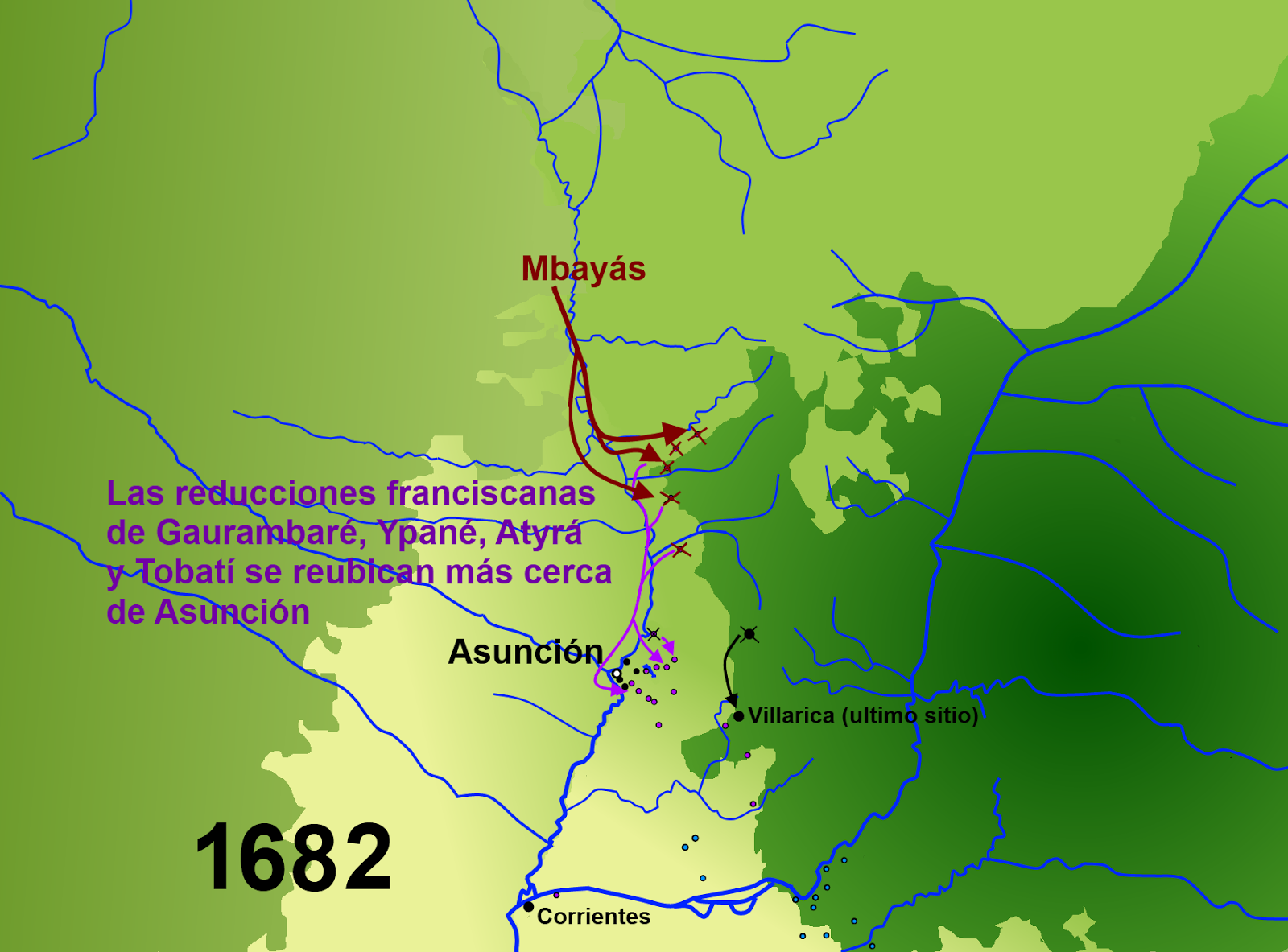
One of the Guaygurú groups which did have a lot of contact with the Spanish were the Mbayás, who moved into northern Paraguay during the 1600's. The Mbayás raided Spanish settlements and missions extensively and succeeded in driving the Jesuits and Franciscans out of northern Paraguay. The displaced Franciscan missions, which included Guarambaré, Ypané and Tobatí, were relocated nearer Asunción. The displaced Jesuit missions relocated still further south, near the long established mission of San Ignacio Guazú, and were renamed Santiago and Santa Maria. Other missions and settlements in the north and on the west bank (Chaco side) of the Paraguay River were abandoned outright due to their attacks.The Guayacurú peoples were successful raiders and were held in grudging esteem by the Spanish for their prowess in their river canoes, but they never adopted a sedentary, agricultural way of life and were gradually displaced and destroyed by the advance of Spanish-Paraguayan technology and population. Today only one group, the Toba-Qom, of this once large language family survives.
Though the modern population of Paraguay is substantially mestizo (a racial mix of European and Native American) it does not seem that the free Guaraní tribes were peacefully assimilated into Paraguayan society. Independent populations of Guaraní were gradually captured to work as slaves, for which there was a constant demand because of the lethality of their living conditions, or driven further into the jungle. Guaraní rebellions were frequent during the 1600's. The Spanish population of Paraguay was always small, and European men sought out Guaraní women as wives. These wives spoke to their mestizo children in Gauraní even as they raised them in a (heavily adapted) European context. Though the Guaraní language survived and even flourished in mestizo Paraguay, much of the rest of the culture was wiped out.
| A Franciscan cathedral in San Pedro |
Those tribes that remained outside of Paraguayan society gradually felt their buffer zones decrease over the centuries. In the mid-1900s Mennonite and Paraguayan military settlement of the Chaco forced most into the light of modern society for the first time. Around the same time, and especially after the establishment of Ciudad del Este (née Ciudad Stroessner) in 1957, the easternmost part of Paraguay began to be heavily settled by Paraguayans. My own town, Natalio, was founded just 45 years ago in the extreme south-east of the country. This part of the country was mostly covered in the dense Atlantic Rainforest and served as a refuge for three Guarani groups, the Mbyá Guaraní (in the south-east), the Ava-Chiripa (central-east) and the Paí-Tavytera (north-east). These peoples speak languages that are similar to Paraguayan Gauraní but use fewer loan words from Spanish. It is also inhabited by two small populations of a hunter-gatherer people called the Ache (or Guayaki). It turned out that this region has the most fertile soil in Paraguay, which has in the last few decades fueled an agricultural revolution. This has meant that the remaining indigenous peoples have been pushed off their lands with greater than usual enthusiasm.
| A settlement of carperos, or landless peasants. This settlement isn't actually made up of indigenous people, but it reflects the poverty that exists in the indigenous settlements. |
Rapaciousness and greed accounted for much of the suffering of these groups in the 20th century, while incompatibility with western culture has accounted for the rest. The question for the future is if the poverty these people live in can be destroyed without simultaneously destroying their unique and ancient cultures.
All photos and maps in this post were created by me.
Bibliography:
Origen e Hisoria de lo pueblos del Paraguay, González Torres, 2010, Servilibro, Asunción Paraguay
Puelos Indígenas en el Paraguay, La Embajada de España en el Paraguay y el Centero Cultural de España Juan de Salazar, 2011, Asunción Paraguay
Encyclopedia Ilustrada del Paraguay y sucesos del mundo vol. 1, colleción Atlas, Atlas
Representaciones 2010, Montevideo, Uruguay
Tuesday, January 8, 2013
Another video: HISTORY
Hey folks!
I've spent the last several months slowly making a video showing the geographic history of Paraguay from the arrival of the Spanish to independence. I cannot offer much in the way of explanation for why I would do this. I think I was motivated by my frustration with the lack of hard information about most of Paraguay's history. I'm also not sure what to do with it, as it is denser than just about really anybody needs. I'd like to make it available as a training material for anyone that is interested in learning about Paraguayan history. I also might try to put it on the Paraguayan wikipedia page. I think a post-independence video would also be ... well something I'd like to do, but I'm not sure if I will have the energy to do it. I am getting better at this with each animation I make (this is the third now) and feedback is appreciated.
The music is Allegro Solmne by Berta Rojas.
oh yeah, the text in the video is in Spanish. Maybe I should make an English version?
enjoy!
Saturday, December 29, 2012
doing my work for me
http://www.economist.com/news/christmas/21568594-how-terrible-little-known-conflict-continues-shape-and-blight-nation
The Economist has an in-depth article linking the history of Paraguay and current events in the country. It's a great read and is really informative about this country in which I reside. I am very tempted to link to it in Spanish on facebook, but that might end up being too controversial.
Highly recommended.
edit 1/5/13
there's a follow-up based on the comments on the article!
http://www.economist.com/blogs/americasview/2013/01/britain-and-paraguay
Thursday, December 27, 2012
on the move
December! It's almost over.
I'd been wanting to go visit Travis and Sybil in Caazapa for some time. They are not too far from me to as the crow flies northeast, but they are located in probably the deepest darkest pocket of the interior of the country and it is not so easy to get there. It turns out there is a bus which leaves Encarnación once a day and passes the highway junction 50km from my site, heads up to Maria Auxiliadora, and then leaves the highway, crosses the rolling fields of that part of Itapua, and then descends into the valley of the Tebicuarymi river. The bus almost arrives in San Carlos, where Trav and Sybil live, but not quite, so it is necessary to hitch-hike the last 10 kilometers.
I left a day early in order to avoid the storms forecast for Friday evening and Saturday. After the bus leaves Maria Auxiliadora the road is mostly dirt, with some particularly steep sections in cobblestone. After a heavy rain no buses come in or out for a day or two.
I met the bus from Encarn at the cruce (junction) Santa Clara around 2pm and the big storm clouds were already rolling in from Argentina. We went north and then east and seemed to be dodging squalls the whole way. The land and sky-scapes were breathtaking.
As we worked our way into and through the valley it was clear the demography had changed as well. The homes were much humbler, there was no sign of tractors or farm machinery or fair-featured German descendants.
My travelling companions and I inquired if there was someone who could be called to take them to San Juan, and I to San Carlos. A cellphone call was made, nothing was certain, perhaps a ride would be available in half an hour. I shared the macadamia nut cookies I had with me, wrapped in aluminum foil, sent by my Grandmother in a package I'd picked up from customs in Encarnación with my boss just two days before.
They all spoke in Guaraní, I smiled and stared off into the distance. The pretty daughter said in Spanish "since you don't speak Guaraní, you'll just have to agree to everything we say".
Not coincidentally, this was also the home of Sybil's boyfriend Cecilio. It is the most "campo" place I've stayed in Paraguay, yet they have strong cell phone service and electricity. Though I've seen it plenty of times before I was still struck when I saw Juan Pablo get a call on his phone, which is nicer than mine, as he was driving the cart.
The family was large and very welcoming. Their home is not small, but seems shockingly provisional to American eyes. The floor is dirt, the walls are rough boards, inside it resembles a dark maze. The family lives in modest self-sufficiency, mostly eating what they grow, occasionally selling cotton or honey or a tree for cash money. The proceeds from the honey sales will be the largest cash profit they will have seen in long while.
Sybil lived for much of her first year of service in a clean and simple cabin they built together near the family house. This is where I stayed the night, after hauling up my well water for my bucket bath, while she slept in the main house with Cecilio. We optimistically talked about the idea of getting up very early and helping plow one of the fields or thin the cotton, but no one was surprised when we opted to sleep in (until 6am!) and walk around the community instead. Later that morning we started walking back in to San Carlos, getting a ride in the dirty oily back of a truck after walking about an hour.
Another volunteer named Hunter came in to hang out for our last day in San Carlos, but he was laid low with a mild fever. The long-predicted rain finally arrived on the morning we were all to leave for Asunción and we had to call a taxi in San Juan Nepomuceno to come and get us. It was an anxious slog through the mud, but the way was mostly flat and the one hill was mounted successfully. Hunter, Sybil, Cecilio (with the 30kg of honey) and I arrived at the terminal just in time for the 1pm Asunción bus and enjoyed a long quiet ride on the asphalt highway. Danny and Cherokee came in four days later with 9 youths in tow for the national Gender and Development camp, while the rest of us enjoyed Ahendu, the thrice annual Peace Corps concert and party at a bar in Asunción followed by a weekend of silliness and extreme heat. After the camp, which was also attended by a precocious youth named Benito from my own site, I returned home, happy to find my belongings undisturbed after two weeks away.
Just a few days later I left again to spend Christmas and Christmas Eve in a town called Carmen del Paraná on the flooded banks of the Paraná river, not so far from the Yacyreta dam. Carmen is now a narrow peninsula and is attempting to cash in as a tourist beach destination. The volunteer couple who live there, Kevin and Joanna Arnold live just two blocks from the new beach, are warm and generous people, and can get unlimited chairs and mattresses on loan from the municipality. They used to work in restaurants and are spectacularly capable of organizing and directing the preparation of delicious meals by and for 20 hungry and possibly intoxicated volunteers.
Now I´m back again. I´ve got no pressing work to do, but should plan and remind folks of my summer reading class and my English class, both of which will start after the New Year. It has been one hell of a year. I look forward to 2013 with guarded optimism (and excitement, despair, curiosity, etc.).
I've been travelling a lot this month. It has been fun and good for my soul. The weather has been very hot, but unlike the endless hell of last summer's drought we are having occasional cooler rainy days, such as today.
This month I went a'visiting to Caazapa, Asunción, Gender & Development Camp in Caacupe, came back to site, and then spent Christmas in Carmen del Parana.
I left a day early in order to avoid the storms forecast for Friday evening and Saturday. After the bus leaves Maria Auxiliadora the road is mostly dirt, with some particularly steep sections in cobblestone. After a heavy rain no buses come in or out for a day or two.
I met the bus from Encarn at the cruce (junction) Santa Clara around 2pm and the big storm clouds were already rolling in from Argentina. We went north and then east and seemed to be dodging squalls the whole way. The land and sky-scapes were breathtaking.
The first stretch out from M. A. was all cobble-stoned and looks just like the countryside around Natalio. There are vast tracts of emerald green soy fields, the dirt is deep purple-brown and many of the settlers appear to be of German descent. The terrain did gradually get hillier as we approached the "cordillera" (mountain range) San Rafael. We passed through the quaint town of Las Mercedes. The bus was old but comfortable enough, it was not very full and the storm-driven breeze was cool and invigorating. The rolling green monoculture continued on until we reached a stark cliff. The valley opened up before us, a rare sight in such a flat country. We began the descent and immediately the land changed. We left behind the potent fertile soil of Itapua. Instead of fields of soy, sunflower, or wheat we were now surrounded by forest, pasture, or small ragged plots of corn and mandioca. The soil was chalky and grey with lots of sand. Apart from the more varied topography it resembled old San Pedro in the north.
As we worked our way into and through the valley it was clear the demography had changed as well. The homes were much humbler, there was no sign of tractors or farm machinery or fair-featured German descendants.
Down in the valley it felt deeply, historically Paraguayan, in the sense of the original Paraguay, inhabited by humble mestizo homesteaders with just a tenuous connection to the outside world. It reminded me quite a bit of San Pedro, but in the valley one does not even feel the vastness of South America stretching dangerously out before you, as one does up north, but rather you feel the insularity of flowering yellow trees, grassy hills, and an not-too-distant horizon.
Sybil I met in college and I admit that I followed her later movements across the globe with some curiosity on facebook. She grew up mostly on the north side of Seattle but also spent about half of every year for many years in Sayulita, a fishing/surfing/Seattlite tourist town in a lovely little bay on the Pacific coast of Mexico. I also had the pleasure of spending a short but beautiful and very memorable two months in that town with my family just after my 14th birthday. It is very likely that Sybil was there at that time but we did not yet cross paths, though we knew some of the same people.
We did meet at Lewis & Clark College, though she studied abroad twice and graduated a year before me. She spent her first year of college studying at the University of Guadalajara with her Mexican boyfriend, and transferred to LC as a sophomore when I was a freshman. Once again, we knew many of the same people. Sybil studied abroad in Munich and Moscow, and then went to live in Slovenia, the birthplace of her grandfather. She applied to Peace Corps from there and began the process of securing Slovenian citizenship. Last year she made a trip down to the Slovenian consulate in Buenos Aires to pick up her new Slovenian passport. She's also lived in Paris and Brazil, and speaks Spanish, French, German, Russian, Slovenian, Portuguese and Guaraní in addition to English.
I also went to visit Travis, an old buddy from my training group, but he encountered some difficulties and had to head back into Asunción. Danny and Cherokee Hope are a Peace Corps volunteer couple who also live in town in San Carlos in a decidedly chuchi (fancy) but also affordable house and who are kind enough to play host to campo volunteers who live in the surrounding countryside (like Travis) and wayward travelers such as myself. Danny and Cherokee are exceptionally sweet and patient people. They hail from Colorado.
The squalls gradually surrounded and enveloped the bus, but the rainfall was never heavy. I got off the bus at the last stop in a place called Enramadita with a grandmother, mother, and child on their way to San Juan Nepomuceno another 30km to the east. We crossed the road to an auto taller (workshop) to ask if they knew of anyone who could convey us in a private vehicle.
The shop was a ramshackle awning connected to a small brick house. There was a battered small SUV with plastic instead of glass in the windows beside a large pile of mysterious small machines, tools, and parts. Sitting tinkering behind a wooden table sat the mechanic, a round blondish man in overalls, his face and clothes colored by grease. He offered us seats in the other corner of the shop. To the north was a view of the green plain and the Ybytyruzú cordillera crossed by shadows and lines of rain, under rolling storm clouds. To the side of the house was the family's latrine, pig pen, and free-roaming chickens. The man's daughter came around from the back of the house, dark-featured and voluptuous in high-waisted blue pants and a squash colored shirt. Around her right eye she had a purple and black bruise from when the SUV had crashed last week. He sister emerged as well, her arm in a sling.
My travelling companions and I inquired if there was someone who could be called to take them to San Juan, and I to San Carlos. A cellphone call was made, nothing was certain, perhaps a ride would be available in half an hour. I shared the macadamia nut cookies I had with me, wrapped in aluminum foil, sent by my Grandmother in a package I'd picked up from customs in Encarnación with my boss just two days before.
They all spoke in Guaraní, I smiled and stared off into the distance. The pretty daughter said in Spanish "since you don't speak Guaraní, you'll just have to agree to everything we say".
Then a yellow pickup truck came down the wet road. It was a government vehicle, though for which agency I did not know. They agreed to take us, but there was only room if we rode in the back. We shouted goodbye to the mechanic and his daughters and quickly jumped in.
Riding in the back of pickup trucks in mysterious lands is one of the singular pleasures of life in our modern world. We each ate another cookie and held on as we bounced over streams and past Eucalyptus plantations. The rain had stopped, the road was sandy and wet, but passable.
In San Carlos with Sybil, her boyfriend Cecilio, Travis (briefly) and Danny and Cherokee we mostly cowered from the heat during the day. At night we all brought our mattresses up to the roof to be in the cool air and slept under the brilliant stars. After two days in town Sybil went out to stay with her former host-family a few kilometers outside of town. When she learned Travis had had to bail, she invited me to come out and stay a night with the family as well. I rode in with Juan Pablo, her host father, on his ox-cart as he returned from delivering 30 kilos of honey to Sybil's house for eventual sale to Peace Corps volunteers in Asunción. Travelling by ox-cart is an very slow but meditative way to travel. We arrived and met Sybil at the homestead just as darkness fell.
Not coincidentally, this was also the home of Sybil's boyfriend Cecilio. It is the most "campo" place I've stayed in Paraguay, yet they have strong cell phone service and electricity. Though I've seen it plenty of times before I was still struck when I saw Juan Pablo get a call on his phone, which is nicer than mine, as he was driving the cart.
The family was large and very welcoming. Their home is not small, but seems shockingly provisional to American eyes. The floor is dirt, the walls are rough boards, inside it resembles a dark maze. The family lives in modest self-sufficiency, mostly eating what they grow, occasionally selling cotton or honey or a tree for cash money. The proceeds from the honey sales will be the largest cash profit they will have seen in long while.
Sybil lived for much of her first year of service in a clean and simple cabin they built together near the family house. This is where I stayed the night, after hauling up my well water for my bucket bath, while she slept in the main house with Cecilio. We optimistically talked about the idea of getting up very early and helping plow one of the fields or thin the cotton, but no one was surprised when we opted to sleep in (until 6am!) and walk around the community instead. Later that morning we started walking back in to San Carlos, getting a ride in the dirty oily back of a truck after walking about an hour.
![]() |
| Danny and Cherokee (and me) at GAD camp |
![]() |
| Gender and Development camp crew |
![]() |
| Benito, Ian, Sybil |
Just a few days later I left again to spend Christmas and Christmas Eve in a town called Carmen del Paraná on the flooded banks of the Paraná river, not so far from the Yacyreta dam. Carmen is now a narrow peninsula and is attempting to cash in as a tourist beach destination. The volunteer couple who live there, Kevin and Joanna Arnold live just two blocks from the new beach, are warm and generous people, and can get unlimited chairs and mattresses on loan from the municipality. They used to work in restaurants and are spectacularly capable of organizing and directing the preparation of delicious meals by and for 20 hungry and possibly intoxicated volunteers.
Now I´m back again. I´ve got no pressing work to do, but should plan and remind folks of my summer reading class and my English class, both of which will start after the New Year. It has been one hell of a year. I look forward to 2013 with guarded optimism (and excitement, despair, curiosity, etc.).
Friday, December 21, 2012
a million words
Hey folks, I was inspired by this video to make one of my own from the random snippets I´ve recorded on my digital camera.
feedback is appreciated.
enjoy!
Saturday, December 1, 2012
Riding in a car
The most beautiful days are the ones when it rains and rains all afternoon and you set your buckets around the house to catch drips and then take a nap and then wake up about an hour and a half before sunset. Then the sun starts to come out before the rain stops even. It is all golden light and a (double!) rainbow lights up in the west. After the day of rain everything is clean and shiny and sparkly and the colors glow with an almost psychedelic brilliance. The puddles reflect the crazy-blue sky and the towering clouds which are at once white, black, yellow, pink and orange. Water trickles through the cobblestones of the streets and a chorus of cicadas and frogs begins as the sun goes down. People come out from their houses after a day shut inside to talk and cook and enjoy the cool evening.
Today was like that and also Thursday.
This evening my neighbors invited me to drive out to their parents' house about 8km outside of town. It is on a cobblestoned road and is passable even after the rain. My neighbors have a nice, clean new car. I wish they didn't park it on my lawn, but well, this is the urban life. But we drove out together in twilight lovely countryside. At the parents house we drank mate and ate honey comb found wild in the woods the day before and savory cornbread (sopa paraguaya). I was the only one who put the honey on my cornbread, which I said was an American custom. I saw fireflies and relished not hearing motorcycles, dogs, sub-woofers, water pumps.
The most striking part of the evening was the simple, nearly forgotten pleasure of riding in a car. In a nice, new, clean car like you would often encounter in the USA. We Americans are raised in cars, we go on so many of our journeys in cars. Tonight was the first time in probably 3 months that I've ridden in one. Nothing could feel more comfortable and correct than a satisfied ride home through the night in those fuzzy grey seats. That is a part of me that goes deep, deep down. It is striking that on such a Paraguayan day the swirling currents of the 21st century global industrial economy would send up to me an experience which was so profoundly familiar in such a distant place.
Subscribe to:
Posts (Atom)