Saturday, February 23, 2013
what is a great day like?
The famous unanswerable Peace Corps question is "what is an average day like?" Unanwserable because each day is so different, or each week, or you forget what is normal and what is remarkable. Or you are doing one thing for a week, or a month, and then never do it again. Or somedays you don't do anything, and you like it. Some days you don't do anything and you hate it.
So, instead of saying what an average day would be, I'd like to write what a great day is like for me.
Saturday 2/23/12
At 8:00am I wake up, reheat some of yesterday's coffee on my gas stove and eat two bananas for breakfast. I sit on my backporch and read La Guerra Civil de 1904, lent to me by the lonely local history buff.
At 9:00am I leave my house and walk around the block to the offices of the two local radio stations, which are side-by-side. I go in and I speak on air with both morning show hosts about an environmental youth group meeting and a public showing of "Toy Story", both at the public library, and about the English class which will start up again in a week and a half.
At 10:15am I ride my bike to library with my speakers and subwoofer in the vegetable crate that is attached to my rear rack. At the library I set up the speakers for the movie this evening and then work on a large welcome sign that I'm making for the library. It is a collage made out of books' dust jackets.
At 11:30am I ride my bike home. I find that my bread is all moldy. The bakery won't make any more until Monday morning. I buy some hamburger buns, ham, and a liter of coke in a cold glass returnable bottle at the store two doors down from my house. I make a sandwich while I listen to NPR's news update and see what's happened on the face-book.
At 1:30pm I ride my bike to the library. I forget the key. I ride the four blocks home, get the key and return to the library. I work on a presentation about how to deal with trash and why not to burn it, for the environmental youth group meeting. I set up the speakers and projector (which I picked up yesterday at the school district office, on the same block as the library) and my computer and rock out to Eddy Grant and the Gipsy Kings and Sidney Bechet while I make color coded dividers for the book shelves.
At 3:10pm Fatima, the leader of the youth group comes in for the meeting. She is starting her Junior year at the local high school. She loves Nirvana and Kurt Cobain. I regale her with stories about Seattle and what I remember of local music growing up (very little). I tell her she might like Modest Mouse and I put on the Moon and Antarctica, I tell her it's called "La Luna y Antarctica" and it's their best album.
At 3:45pm Fernando shows up for the meeting. Fatima asks me if I know the bridge which Kurt Cobain slept under. I say I didn't. She asked if I knew the Jimi Hendrix statue. I say I did, it's up in Capitol Hill in front of an Everyday Music store. We talk about the group, if anybody else is coming, about how cool it is to have free, thrice weekly trash pickup. We watch a movie clip about a community near Asuncion that has a student orchestra that builds instruments out of things found in the the giant landfill. We end up planning to meet n my front yard in two weeks to make drinking glasses from old wine bottles. I try not to stress just how many old wine bottles I have.
At 4:25 Carolina, the librarian arrives on her dirt bike with her leopard-print purse in one hand and a large plastic grocery bag of fresh popped popcorn in the other. She's also got her brand-new thermos, with her name, the name of her university, her major, and the coat of arms of the university embroidered in the black and blue pleather. It's about 90F in the library, we've got all the fans on full blast and some doors and windows open, but we'll need it to be dark once we start the movie. The three neighborhood kids come. I put on Planet Earth: Mountains to test out the projector and sound. Twice the power regulator overheats and shuts everything off. I'm not sure if anyone else will come.
At 5:25pm we start "Toy Story". About 20 kids and 3 moms have arrived. We're charging 1,000 Gs. or about 25 cents at the door. Popcorn is also 25 cents. I'm able to figure out the technical difficulties such that the projector only shuts off once during the movie. Another 6 or 7 kids come in later. In total we make just four dollars after we pay the woman who made the popcorn.
At 6:45 the movie ends. I get a text message that my samba drum group is meeting at 7:00pm, that we'll be playing tonight at the Carnaval parade in Maria Auxiliadora, which was rained out last weekend. I clean up with Carolina. We walk out to the gate and she tells me she doesn't like it how I roll up my pant legs when it's hot. I tell her it makes me feel like a pirate.
At 7:00pm I ride my bike to Manu's house. There's road work (cobblestoning) on several of the streets, and I maneuver carefully with my messenger bag and laptop in the cargo crate in back. At the meeting we decide we'll meet up again at 9:00pm to board the bus. I ride home. I pass a wild-haired girl wearing purple pants and a light-green dress. Grey clouds stand out against against an orange sky in the east above vines and banana trees as I ride down the road from Manu's. A 10 year-old student of mine named Cristian is riding behind his father on a motorcycle, they turn onto my street and then pass me by. Cristian and I make faces at each other as they accelerate and leave me behind.
At 7:30 I am home again. I take of my shirt and pour a cold glass of water from the green bottle in my fridge. I reheat Thursday's pasta. I put on water to make more coffee, to help keep me going until 5am or so when we'll come back from Maria Auxiliadora. I'll try and write a blog post and take a shower before we leave.

Saturday, February 16, 2013
watercolor evenings
It's a glowing evening here in Paraguay, even in my noisy, ugly neighborhood. There are a lot of ways in which Paraguay does not measure up very well, but the quiet evenings, in vast lush country, with spectacular sunsets, is one area in which Paraguay excels.

I've been teaching a little remedial reading class for elementary schoolers on Tuesdays and Thursdays at the library and teaching English classes there for youth those afternoons. While the goal of the reading class is to help these kids out, the English class is really just a sneaky way for me to get warm bodies into the library. It's been successful in that and it's also been pretty fun to get to know the youths.
The municipality has suddenly and spectacularly sprung into action this month, after four months of inaction (they receive a big chunk of money annually from the hydroelectric dams around the New Year I think). They finally fixed the voltage issues that had prevented us using any of our computers and they paid to build a really nice porch and extended roof in the back part of the library. The roof extension was necessary because the whole place would turn into a big puddle every time it rained from water would runs under the back-double-doors.
 |
| English class in the library |

It's so much more fun to work with Carolina and to teach my classes that I was shocked yesterday when I went to visit the school I'd been in last spring. The overwhelming indifference I encountered was so familiar from last year; my soul winced at that memory.
I am so proud of the library. I can't take credit for it all, but I was behind much of the establishment of the space and how it feels. And I find it so satisfying now. The experience has reminded me a lot of working with the student co-op in college. The co-op was ostensibly a coffee shop, but it's most important function was to serve as a comfortable student-controlled space on campus. Relying on student volunteers meant there was a lot of dysfunction, and attempting to work with the college administration meant there was always plenty of misunderstanding and opaque bureaucracy, but I really loved putting in the menial hours tinkering to make it a special place.
In my last three months as a volunteer I've got lot of exciting things I'd like to get done. If they don't all come through, so be it, but I'm trying to give a Diagnostic Testing workshop to area teachers, possibly give a didactic materials workshop at the school I worked at last year, do another 6-week English class, paint a world map on the back wall at the library, receive the box of books sent to the library by Darien Book Aid, visit the little schools a few km from town to give a quick one-day all-out didactic materials/book reading/interactive lessons demonstration, complete all my PC and grant related paperwork, , take more pictures in Asuncion, take Carolina to the National Peace Corps Libraries workshop in May, visit Nueva Germania, Quiindy (cousin Bryan's old site), Benito in Ayolas, sell/divest my stuff, and figure out where I'm going next and what I'm bringing with me.

And I love summer! And just how great it all feels to be in a period of change and newness again!
My bike is severely messed up so I haven't been enjoying my occasional rejuvenating rides in the surrounding countryside, but I've been feeling the mythic rolling fields closer in than before. I can sense them even from my house, which recently seemed to be so visually and acoustically foul. I'm so glad I didn't go home early, that I waited it out and that things have now come together so well and so unexpectedly.
Monday, February 11, 2013
Carnage
I'm not a good enough writer (or thinker or feeler) to properly capture the experience of my Carnaval in Paraguay, but I hope that these pictures may convey the general feeling. There is no carnaval celebration in the north where I lived last year, so this is my first carnaval in South America. It's not like anything I've ever seen or heard or felt before.

I've been performing with the Batucada samba drum group in my town which has been a really cool and totally new experience. It's composed of about 25 youths, aging from about 12-22 years old. The core members organized themselves five years ago, started practising with buckets and whatever they could find, held fundraisers, bought drums, and have grown and improved year after year. We've performed in five corsos now (carnaval parades), twice in Natalio the weekend before last, once in Capitan Meza last Friday night, and twice in Yatytay, last friday and then again last night.
The towns in this part of Itapua rotate hosting carnaval weekends with parades and all the neighboring towns send performance groups of dancers and drummers (mostly dancers) to perform and compete for prizes in whichever town is hosting that weekend. This weekend both Capitan Meza and Yatytay were hosting, so we played at both Friday night. On the second night of the corsos (theoretically Saturday, but delayed to Sunday both weekends because of rain) prizes are awarded to the best groups; our group won first prize both times. The prize was almost $200 for the Natalio carnaval, which I think will just go to drum purchase and maintenance. We got invited to a carnaval in the middle-of-nowhere town of Itapua Poty in two weeks which will have a top prize of $400.
I love playing with the group, it is quite challenging and fun and the combined effect of so many drums is exhilarating The performance is challenging as well, but I have now twice been surprised when we've won top place, despite my many errors and perceived general dis-coordination.
What's hard about participating in the group is passing the many hours waiting to perform. The group is mostly composed of teenage boys, and they can be just as obnoxious and rude and stupid as teenage boys can be anywhere. I feel very comfortable with most of the other players, but there are a couple of clowns who love to taunt me.
"Norteamericano, Hello Norteamericano! Goodmorning! One, two, three, Hello Baby!"
I'm working at being better at joking around, but these guys are really awful. I remember kids just like them when I was in High School. I'm not going to fight them, I can't verbally jab at them with my accented and awkward Spanish. I try and maintain some quiet dignity, but doesn't feel very effective. Some things never change I suppose.

We got back last night at 3:30 am. It is really incredible how wholeheartedly these conservative small towns go in for a party. The most popular thing for spectators to do is buy aerosol cans of spray foam and mercilessly spray each other. I don't think I've ever seen anyone wearing safety goggles in Paraguay except for the in bleachers at Carnaval. Beer is for sale of course, proceeds go to help fund the prizes for performers. The carnaval in Yatytay was sponsored by the volunteer firefighters, they were using the ambulance (flashing lights, but no siren) to deliver ice to the beer stand last night.
Fortunately I have no major commitments today. Last Monday I had a 7am meeting with the mayor, after getting home around 2:40 am. And it's a rainy day so I'm hanging out around the house and drinking coffee. I just made a lentil stew for lunch.

I've been performing with the Batucada samba drum group in my town which has been a really cool and totally new experience. It's composed of about 25 youths, aging from about 12-22 years old. The core members organized themselves five years ago, started practising with buckets and whatever they could find, held fundraisers, bought drums, and have grown and improved year after year. We've performed in five corsos now (carnaval parades), twice in Natalio the weekend before last, once in Capitan Meza last Friday night, and twice in Yatytay, last friday and then again last night.
The towns in this part of Itapua rotate hosting carnaval weekends with parades and all the neighboring towns send performance groups of dancers and drummers (mostly dancers) to perform and compete for prizes in whichever town is hosting that weekend. This weekend both Capitan Meza and Yatytay were hosting, so we played at both Friday night. On the second night of the corsos (theoretically Saturday, but delayed to Sunday both weekends because of rain) prizes are awarded to the best groups; our group won first prize both times. The prize was almost $200 for the Natalio carnaval, which I think will just go to drum purchase and maintenance. We got invited to a carnaval in the middle-of-nowhere town of Itapua Poty in two weeks which will have a top prize of $400.
I love playing with the group, it is quite challenging and fun and the combined effect of so many drums is exhilarating The performance is challenging as well, but I have now twice been surprised when we've won top place, despite my many errors and perceived general dis-coordination.
What's hard about participating in the group is passing the many hours waiting to perform. The group is mostly composed of teenage boys, and they can be just as obnoxious and rude and stupid as teenage boys can be anywhere. I feel very comfortable with most of the other players, but there are a couple of clowns who love to taunt me.
"Norteamericano, Hello Norteamericano! Goodmorning! One, two, three, Hello Baby!"
I'm working at being better at joking around, but these guys are really awful. I remember kids just like them when I was in High School. I'm not going to fight them, I can't verbally jab at them with my accented and awkward Spanish. I try and maintain some quiet dignity, but doesn't feel very effective. Some things never change I suppose.

We got back last night at 3:30 am. It is really incredible how wholeheartedly these conservative small towns go in for a party. The most popular thing for spectators to do is buy aerosol cans of spray foam and mercilessly spray each other. I don't think I've ever seen anyone wearing safety goggles in Paraguay except for the in bleachers at Carnaval. Beer is for sale of course, proceeds go to help fund the prizes for performers. The carnaval in Yatytay was sponsored by the volunteer firefighters, they were using the ambulance (flashing lights, but no siren) to deliver ice to the beer stand last night.
Fortunately I have no major commitments today. Last Monday I had a 7am meeting with the mayor, after getting home around 2:40 am. And it's a rainy day so I'm hanging out around the house and drinking coffee. I just made a lentil stew for lunch.
Tuesday, January 29, 2013
motion
There is nothing better than travel to jolt ones mind out of rutted tracks. One of the benefits of Peace Corps service is the near-constant opportunity and obligation to travel, at least within the host country. If much of this travel is unglamorous and exhausting we may better appreciate the times it is refreshing and exhilarating.
I'm back from a week about in San Bernadino, La Colmena, Asuncion and Luque for respectively our CloseOfService Conference, a trip with nearly our whole training group (G-35) to a beautiful waterfall called Salto Cristal, office business and a Sunday visit to a friend. I arrived back in town five hours before my Tuesday morning reading class, which was fun and heartwarming as usual.
 |
| Salto Cristal |
 |
| G-35 Living it up |
I've got some un-Peace Corps related ideas I'd like to get down before they get any more corrupted by habitual thinking...
Gun control: I've actually had my opinion mature about gun control, which surprises me given the intransigence and vitriol that generally accompanies it in the public discourse.
1) The USA's annual rate of shooting-deaths is insanely, unacceptably high.
2) The USA also has a rate of gun ownership much, much higher than comparable countries.
Therefore: it is too easy to get guns in the USA.
3) Most shooting victims are shot by handguns. Scary rifles are the instrument of few American civilian deaths.
4) Mexican drug cartels purchase guns in the USA because it is really easy to do so. These assault weapons are used against the Mexican Army, Police, and citizens at large.
Therefore: restrictions on purchasing assault weapons should be strengthened, but we shouldn't expect this to lead to a significant decrease in domestic shooting-deaths.
5) It is an American right for citizens to own guns for hunting or protection.
6) A gun in the home is more likely to harm its owner than an intruder. "In the 1990s, a team headed by Arthur Kellermann of Emory University looked at all injuries involving guns kept in the home in Memphis, Seattle and Galveston, Tex. They found that these weapons were fired far more often in accidents, criminal assaults, homicides or suicide attempts than in self-defense. For every instance in which a gun in the home was shot in self-defense, there were seven criminal assaults or homicides, four accidental shootings, and 11 attempted or successful suicides." NYT editorial
7) It is extremely difficult to effectively confront a mass-murder in the heat of the moment even for experienced soldiers and police officers.
Therefore: Gun ownership ought to entail considerable responsibilities, including training, background checks and registration of all owned firearms.
Jobs:
1) I am well positioned compared to the average american. I am well-educated, supported by stable family members, smart, talented, without a criminal record. To top it off I am a straight white male, which presumably still has its implicit advantages (I don't think that's fair or right, I'm just saying). I will shortly be a returned Peace Corps Volunteer, which I am told carries some weight, in a general sort of way.
2) I have negligible experience doing specific skilled jobs.
3) There are many many people in my age-cohort with similar qualifications (good education, stable backgrounds, good at lots of general things, etc.)
4) The pool of well-paid, satisfying jobs is small. The so-called creative-class are the people who have jobs which involved creative output, thinking and making decisions essentially. Teachers, managers, planners, lawyers, doctors, consultants, executives, engineers, writers, journalists, designers, etc. and make on average $80,000 per year.
5) The rest of the job-sector is made up of blue-collar work (factory, construction, transportation jobs) and the service sector (food service, retail, cleaning, etc.). The service sector is the least paid and fastest growing part of the economy, while the blue collar sector is shrinking. These classes both on average earn between $25,000-$40,000 a year (service sector is at the lower end).
6) Much, possibly most, of my generation is trained for and aspires to creative-class jobs. Blue collar work, upon which the USA was physically and spiritually founded, is decreasingly common, decreasingly well-paid and is treated dismissively in much of what we tell young people about what they should do when they grow up. To work in the creative class is essentially the only way to participate in the American Dream (safe, stable family life, ownership of a comfortable home and comfortable cars, assurance of quality health-care and education for the whole family, difficult but satisfying work) in modern American society.
"the more fundamental long-term problem is that there is simply something of a mismatch between the expectation of students and also the reality of the job markets. We have do have four million retail sales clerks in the United States. These are not very glamorous jobs but there are a lot of them, and those are still growing in number. We have a lot of home health care aides and truck drivers and plumbers and electricians. More and more and more of our 22-year-old young adults have college degrees. They're not all going to get jobs as scientists and managers. Some of them are going to be almost forced by the sheer numbers into these other kind of positions." - Dr. Vedder, University of Ohio
7) I am a democrat. I admire and esteem the life of the average person, I believe in the wisdom and virtue of the population at large. I think beauty can be found in a simple life and that material wealth does not equate happiness or necessarily evince a life well-lived.
8) While there will be competition for jobs and status within the creative class, the greatest competition, the existential competition, will be amongst those who are trying to get in to the creative class and stay there.
9) I aspire to an interesting, well-compensated job that will allow me to pay off my student loans and also live the middle class American Dream (which I may modify with bicycles instead of cars and urban density instead of suburban). Therefore I must spurn my democratic impulses and try to claw my way into is 35% of the working population (to be fair I was born into it, so I suppose it's just clawing out my own nook) of whom consist the creative class.
Therefore: I've got to decide on what I want I want to do in the next years of my life and make it happen. I'm not going to "sell" myself, because I don't believe in buying or selling human beings, but I've got to promote myself as a job candidate to out-compete my peers for those good jobs.
 |
| what comes next? |
http://www.theatlanticcities.com/neighborhoods/2013/01/class-divided-cities-new-york-edition/3819/
http://www.theatlanticcities.com/neighborhoods/2013/01/class-divided-cities-los-angeles-edition/4296/
http://www.nytimes.com/2013/01/29/opinion/brooks-a-second-g-o-p.html?hp
http://www.salon.com/2013/01/29/i_came_home_to_a_sleeping_country/
Friday, January 18, 2013
Real Life
Today was frustrating, but the last two weeks have been fine. I've got two summer classes going at the library, one for 3rd and 4th graders who are having trouble keeping up, and an English class. The English class three lessons in is now quite large, after several false starts in which not one person showed up. I'm really not very interested in teaching English, I don't see the point of it, as it just helps out folks that are already doing okay. It really is just a sneaky way for me to get people into the library, so that they start to feel comfortable and to get to know the place. In this it has already been a success. I've also been participating in the samba drum group called Batukada which will perform during carnaval. This has been a lot of fun; it's been great to learn something new and to get to know these enthusiastic and organized youths. And there's been neighborhood volleyball and there's a bumper crop of mangoes and lots of time reading in the hammock, and all that. It's been pretty okay, I tell you.
There is a funny thing, as we start getting ready to leave, about what we are leaving and what we are going back to. In a lot of ways, in the way we deal with it bureaucratically and socially it's like we're going back to our real lives after a 27 month intermission. And that makes sense when we are in our American minds and we think about ourselves and future careers, cities we want to live in, ethnic cuisine, bicycles, cars, houses with carpeting and heating and 24-hour running water, pets and houseplants and complex artistic expressions and postmodern social norms. But it is also very true that these two years have been real life, most especially because we are living with people who are really living their real lives. Talking to people in Itapua, many of whom are solidly middle-class, with cars and tvs and water tanks (so they have water all day) and maybe AC and such, who don't feel like their lives are lacking in anything, it is hard for me to go back to that American mind and say why it is exactly that I am leaving, that I'm definitely leaving, and I'm not even really tempted to stay.
It is hard to bridge this gap, between the Paraguayans we care about that are living their real lives, and our distant real lives which are waiting for us in April or in May. It must be incomprehensible to Paraguayans that we would choose to leave our homes and families, show up in Paraguay, work and get to know and love people for two years, and then up and leave again all of a sudden. But then, Paraguayans do tend to have a great tolerance for the incomprehensible.
The only volunteers that really bridge this gap are the ones that marry a Paraguayan (or "host country national" in whichever country they serve). They make a commitment to bind their old real life to their new Paraguayan real life, to try to tie these two cords together in what can only be a messy knot. Short of marriage, there are only promises of future visits, which always end up being few and fleeting, and phone calls and facebooks and possibly letters to try and keep a few strands of affection intact.
How can we really engage with someone if we consider their whole world to be at worst a nightmare or at best a farce? If we would find their every expectation of quality unacceptably low or too unsafe, too ugly, too cheaply made?
Relativity and disparity and sincerity will make your head spin.

I have yet to spend a night outside this country since I arrived just under two years ago. This is mostly a planning oversight of mine, combined with accidents of timing, and was not what I intended to do. Today though, as I rode the bus out to the river port, and the ferry across the river I was filled with excitement and quite a bit of anxiety. I am comfortable in Paraguay, things that happen can be odd or annoying but they do not surprise me much. I know what to expect and I know how I like to do things in Paraguay. (Eat chipa during long bus rides, drink beer during long bus waits, eat bananas and coffee for breakfast, be friendly with everyone, ask for favors, ask at least 5 different people to confirm directions or timetables, don't touch anything clean after touching anything, don't go out or expect anything to happen in the early afternoon, think about which side of the bus will be in the sun once you leave town, bring a blanket for long rides on air-conditioned buses, pay with the largest bill you think can get away with, keep very low expectations for punctuality, make sure you've got enough groceries to last the weekend before noon on Saturday, don't buy "hot" food between 3pm and 7pm, don't tell anyone when you've been combining terere and mango or watermelon and wine, wear a hat, put lemon leaves in terere, put anis and cinnamon or cloves in your máte, use orange thorns to pick teeth or extract chiggers.) Modern, industrialized Argentina, about which I've been fantasizing for so long, would be unpredictable and strange and foreign.
However, I was denied access to Argentina because of a very new "reciprocity fee" which must be paid online or at the consulate. This fee was previously only charged at airports for Americans flying in.
So I'm still in Paraguay. It does seem inevitable. But I will leave in four months with a backpack on my back to go wandering in Argentina and Chile, and then back to the world that was everything I'd known and everyone I'd known almost two and a half years before.
Wednesday, January 9, 2013
La Historia III - Los Indios y los Missioneros
Well, so far we've got
La Historia I about the establishment of the Spanish Empire
and
La Historia II about the Paraguayan colony and the Spanish settlement of South America
but
The part of the story which I have neglected to tell is of the native inhabitants of the lands that were to become Paraguay. The information I've come across has been incomplete or inconsistent, but I'll do my best to give a good summary of what I've figured out.
Before the arrival of Europeans, South America was inhabited by many native peoples with very different ways of life. The had some degree of contact with one another, especially when one group would migrate or invade the territory of another. That could cause them in turn to migrate into the territory of a third group and so on.
The best known people are the Inca, who originated in Peru and by 1450 had an empire stretching from Ecuador to Chile. I've already written about how the Spanish incorporated much of the structure of this empire into their South American dominion. The Inca were agricultural and obviously advanced organizationally, though they never developed either writing or the wheel.
Tupi-Guarani is a language family that included many groups of people in eastern South America, stretching from the Amazon and the north of modern-day Brazil to the Rio de la Plata. Mostly they were semi-sedentary, meaning they practiced agriculture, but not intensively. They acquired some domesticated crops from the Inca (corn, sweet potatoes, squash, beans) and domesticated some of their own (peanuts, mandioca, cotton).
 |
| Tupi (violet), Tupi-Guarani (pink) languages areas and early probable areas (pink-grey). |
The Guaraní usually lived in settlements of a few hundred families. They built large communal homes, grew corn, mandioca, sweet potatoes, peanuts, tobacco and squash and hunted and harvested many wild plants (they were "Neolithic"). They prized colorful bird feathers, which they used to make elaborate masks and costumes. River tribes traveled and made war by canoe and terrestrial tribes moved on foot. Because they covered such a wide territory and were so numerous Guaraní served as a lingua franca in the region.
 |
| dark blue = Guaraní groups, dark red = Guaycurú groups |
The Guaycurú language family included many paleolithic groups that occupied the Chaco near the Paraguay River. This family included the Payaguá, Mbayá, Toba and Abipón all of which were very hostile to the Spanish and raided Spanish-Paraguayan settlements into the 1800s. These peoples were highly skilled river navigators, using large dugout canoes. The Chaco was also inhabited by a mishmash of smaller groups. The Chané, in the south-western Chaco were a part of the Arawak language family which primarily inhabited the Caribbean, while the Lulé were not related to any other known language group. The several related groups known to the Spanish as the Lengua occupied the central Chaco. Meanwhile in the eastern region some groups were surrounded but not displaced by the Guaraní and maintained their hunter-gatherer lifestyles such as the Aché or "Guayaki".
When the Spanish first arrived in this part of South America they clashed with the paleolithic natives they encountered near the Rio de la Plata estuary (near Buenos Aires), but travelling up the river they encountered groups of Guaraní which they found to be more peacefully inclined. It was from the Guaraní that the Spanish first learned of the Inca Empire and its riches.
When the Spaniards permanently set up shop in this part of South America, in Asunción in 1537, they began to interact with the natives in new ways. Spanish adelanteros began to establish feudal estates called encomiendas, taking advantage of forced indian labor. The natives were captured or bought and used as slaves. This, along with subsistence farming, was the chief economic activity of the colony up until and even after independence in 1811. Meanwhile, starting in 1580 the Franciscan order set out to establish "reductions" of groups of Guaraní to convert them to Christianity. These establishments did send natives back for forced labor in the Spanish encomiendas but they provided a degree of protection and economic development for the Guaraní subjects and began to integrate them into the Spanish colonial empire.
These missions were founded near Asunción and also further north on the east bank of the Paraguay River.
When the Jesuit order arrived in the region in 1610 they took things up a notch. The Jesuit reductions, unlike those of the Franciscans, did not send Guaraní laborers back to work on the encomiendas. In fact, the only Europeans allowed to enter the missions were the Jesuit monks assigned to them. Currency was also forbidden; all labor and all goods were collectively shared, under the oversight of the Jesuit fathers. It was a highly paternalistic system, but provided needed protection from the Spanish colonists and allowed the Guaraní to enjoy some of Europe´s more benign imports. Schools were established; western music, painting, and carving were taught and nurtured in the missions, which also became increasingly ambitious architecturally. The Society of Jesus was something of an avant-garde organization for Europe in the 1600's and 1700's and many gifted and adventurous individuals were inspired to come to Paraguay to participate in their utopian project.
 |
| The unfinished ruins of Jesus de Tavarangue |
 For me, the Jesuits are fascinating because of the adventurous and earnest spirit with which they undertook their projects in this part of the world, when there were no roads, self-propelled transportation, communication devices, modern medicines, or nearly any other of the many conveniences that I enjoy. Even so, I cannot help felling that we, as Peace Corps volunteers in Paraguay, are following in their legacy. They left behind their (17th century) European comforts to come to an unknown, wild and dangerous part of the world because they thought they knew something they could share that would help improve the lives of the people they encountered.
While the ideas the Peace Corps seeks to share are quite different, the essential impulse is unchanged: to travel to a foreign land in the service of an abstract cause or ideal. It is the flip-side of that expansive European desire which lead the Spanish and Portuguese and French and Dutch and English to build their far-flung empires, subjugating and dominating foreign, unknown lands and peoples. We volunteers and missionaries (there are two Jehovah´s Witness missionaries and two Mormon missionaries also living in Natalio) come to places where we have no real, immediate business outside of a general desire to help others or to do the right thing. In that sense people might be correct when they accuse us of being part of American imperialism.
 |
| Dan and I at the ruins of Trinidad, about 2 hours by bus east of my site. |
 |
| The mid-1600's saw a lot of retrenchment for the young colony |
 One of the Guaygurú groups which did have a lot of contact with the Spanish were the Mbayás, who moved into northern Paraguay during the 1600's. The Mbayás raided Spanish settlements and missions extensively and succeeded in driving the Jesuits and Franciscans out of northern Paraguay. The displaced Franciscan missions, which included Guarambaré, Ypané and Tobatí, were relocated nearer Asunción. The displaced Jesuit missions relocated still further south, near the long established mission of San Ignacio Guazú, and were renamed Santiago and Santa Maria. Other missions and settlements in the north and on the west bank (Chaco side) of the Paraguay River were abandoned outright due to their attacks.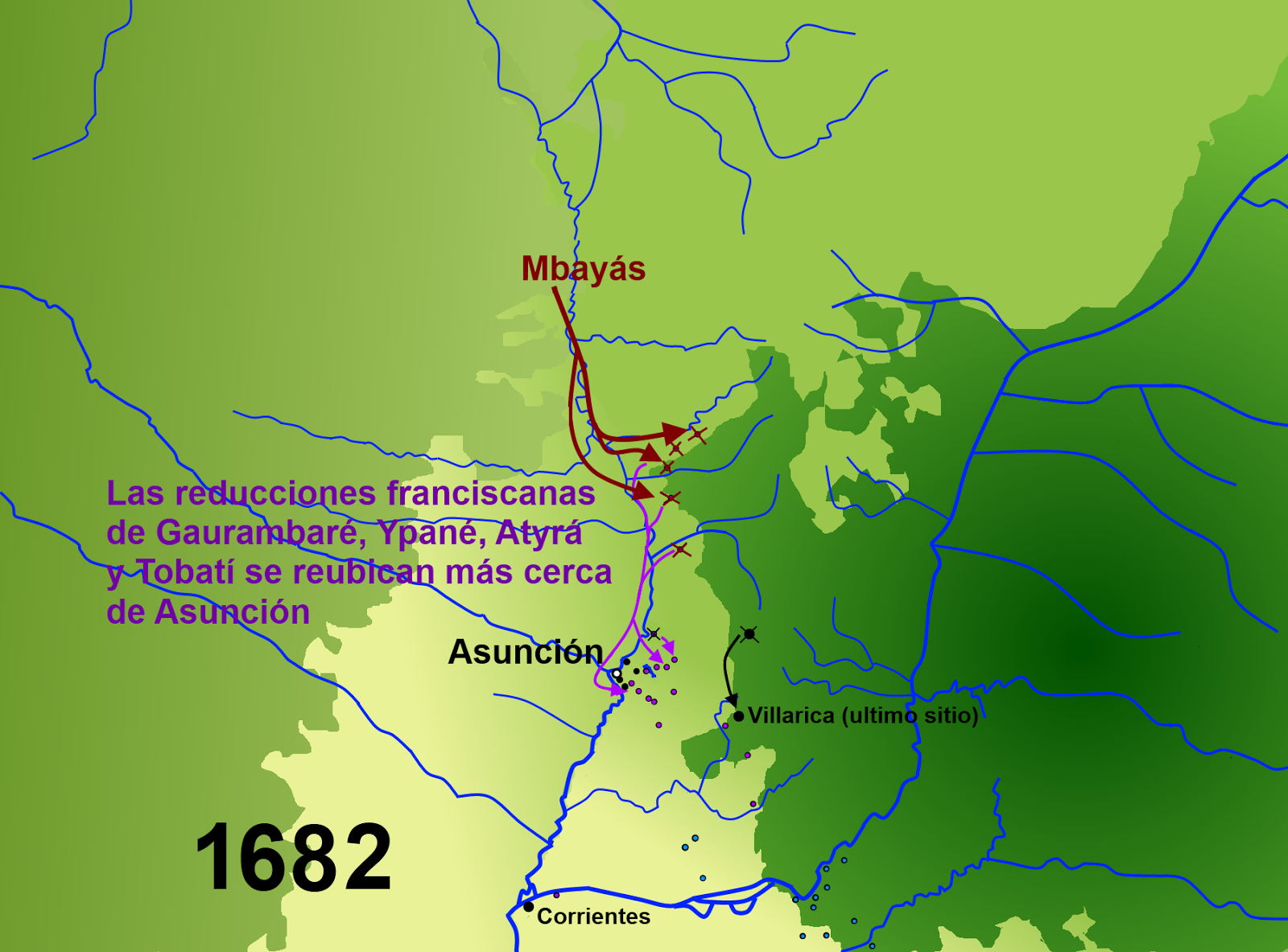
Though the modern population of Paraguay is substantially mestizo (a racial mix of European and Native American) it does not seem that the free Guaraní tribes were peacefully assimilated into Paraguayan society. Independent populations of Guaraní were gradually captured to work as slaves, for which there was a constant demand because of the lethality of their living conditions, or driven further into the jungle. Guaraní rebellions were frequent during the 1600's. The Spanish population of Paraguay was always small, and European men sought out Guaraní women as wives. These wives spoke to their mestizo children in Gauraní even as they raised them in a (heavily adapted) European context. Though the Guaraní language survived and even flourished in mestizo Paraguay, much of the rest of the culture was wiped out.
 |
| A Franciscan cathedral in San Pedro |
Those tribes that remained outside of Paraguayan society gradually felt their buffer zones decrease over the centuries. In the mid-1900s Mennonite and Paraguayan military settlement of the Chaco forced most into the light of modern society for the first time. Around the same time, and especially after the establishment of Ciudad del Este (née Ciudad Stroessner) in 1957, the easternmost part of Paraguay began to be heavily settled by Paraguayans. My own town, Natalio, was founded just 45 years ago in the extreme south-east of the country. This part of the country was mostly covered in the dense Atlantic Rainforest and served as a refuge for three Guarani groups, the Mbyá Guaraní (in the south-east), the Ava-Chiripa (central-east) and the Paí-Tavytera (north-east). These peoples speak languages that are similar to Paraguayan Gauraní but use fewer loan words from Spanish. It is also inhabited by two small populations of a hunter-gatherer people called the Ache (or Guayaki). It turned out that this region has the most fertile soil in Paraguay, which has in the last few decades fueled an agricultural revolution. This has meant that the remaining indigenous peoples have been pushed off their lands with greater than usual enthusiasm.
 |
| A settlement of carperos, or landless peasants. This settlement isn't actually made up of indigenous people, but it reflects the poverty that exists in the indigenous settlements. |
Rapaciousness and greed accounted for much of the suffering of these groups in the 20th century, while incompatibility with western culture has accounted for the rest. The question for the future is if the poverty these people live in can be destroyed without simultaneously destroying their unique and ancient cultures.
All photos and maps in this post were created by me.
Bibliography:
Origen e Hisoria de lo pueblos del Paraguay, González Torres, 2010, Servilibro, Asunción Paraguay
Puelos Indígenas en el Paraguay, La Embajada de España en el Paraguay y el Centero Cultural de España Juan de Salazar, 2011, Asunción Paraguay
Encyclopedia Ilustrada del Paraguay y sucesos del mundo vol. 1, colleción Atlas, Atlas
Representaciones 2010, Montevideo, Uruguay
Tuesday, January 8, 2013
Another video: HISTORY
Hey folks!
I've spent the last several months slowly making a video showing the geographic history of Paraguay from the arrival of the Spanish to independence. I cannot offer much in the way of explanation for why I would do this. I think I was motivated by my frustration with the lack of hard information about most of Paraguay's history. I'm also not sure what to do with it, as it is denser than just about really anybody needs. I'd like to make it available as a training material for anyone that is interested in learning about Paraguayan history. I also might try to put it on the Paraguayan wikipedia page. I think a post-independence video would also be ... well something I'd like to do, but I'm not sure if I will have the energy to do it. I am getting better at this with each animation I make (this is the third now) and feedback is appreciated.
The music is Allegro Solmne by Berta Rojas.
oh yeah, the text in the video is in Spanish. Maybe I should make an English version?
enjoy!
I've spent the last several months slowly making a video showing the geographic history of Paraguay from the arrival of the Spanish to independence. I cannot offer much in the way of explanation for why I would do this. I think I was motivated by my frustration with the lack of hard information about most of Paraguay's history. I'm also not sure what to do with it, as it is denser than just about really anybody needs. I'd like to make it available as a training material for anyone that is interested in learning about Paraguayan history. I also might try to put it on the Paraguayan wikipedia page. I think a post-independence video would also be ... well something I'd like to do, but I'm not sure if I will have the energy to do it. I am getting better at this with each animation I make (this is the third now) and feedback is appreciated.
The music is Allegro Solmne by Berta Rojas.
oh yeah, the text in the video is in Spanish. Maybe I should make an English version?
enjoy!
Subscribe to:
Posts (Atom)